
Vitamin D, B12 and Memory After 60: When Low Levels Matter, and When They Don't
Two vitamins come up constantly in brain-health marketing. Both matter for the brain, and both matter mostly when you are low.
Why these two vitamins matter more after 60
Older skin makes less vitamin D from sunlight, and many older adults spend more time indoors. Stomach acid also falls with age, which reduces how much B12 the body can absorb from food. Both shortfalls are common, often silent, and easy to test for[1][3].
B12: a reversible cause of memory problems
Vitamin B12 is needed for healthy nerves and blood cells. True deficiency can cause memory loss, confusion, numbness, tingling and anemia, and these effects can improve with treatment, which is why doctors check B12 in anyone with new cognitive complaints[5]. Long-term metformin, proton pump inhibitors and H2 blockers all reduce B12 absorption[3].
What about people who are only mildly low? A randomized trial in people over 70 with mild deficiency found that 24 weeks of oral B12 corrected blood markers but did not improve memory or other cognitive scores[4]. B12 prevents the damage of deficiency; it does not act as a cognitive enhancer in people with adequate levels.
Vitamin D: strong associations, mixed trials
Vitamin D receptors are found throughout the brain, and low vitamin D has been linked with faster cognitive decline in observational research. In one large analysis of U.S. Alzheimer's research center data, people taking vitamin D supplements had about 40 percent fewer dementia diagnoses over about ten years[2]. That is a striking association, but it comes from observational data, where healthier lifestyles among supplement users can explain part of the difference.
Randomized trials of vitamin D for cognition have produced mixed results[1]. The reasonable approach is to keep your level in the normal range rather than to take high doses in the hope of protecting memory.
Doses and upper limits
- Vitamin D RDA: 600 IU (15 mcg) to age 70, 800 IU (20 mcg) after. Upper limit: 4,000 IU (100 mcg) for adults unless prescribed.
- Vitamin B12 RDA: 2.4 mcg. No upper limit has been set; supplements commonly provide 25 to 1,000 mcg because absorption at higher doses is a small percentage.
- Add up all sources: multivitamins, separate supplements and fortified drinks or powders.
When to ask for a blood test
- New or worsening memory problems, numbness or tingling, fatigue or anemia: ask about B12.
- Long-term metformin or acid-reducing medicine: ask about B12 periodically.
- Little sun exposure, darker skin, obesity or osteoporosis: ask about vitamin D.
- Already supplementing at high doses: ask whether your level is too high.
Which forms to choose
Vitamin D3 (cholecalciferol) raises blood levels more reliably than D2 in most studies and is the form most supplements use. For B12, cyanocobalamin is the most stable and best studied, and the body converts it to the active forms; methylcobalamin is a popular alternative with no clear advantage for most people. If a product's advertising and label name different forms, the label is the one that counts.
Where combination products fit
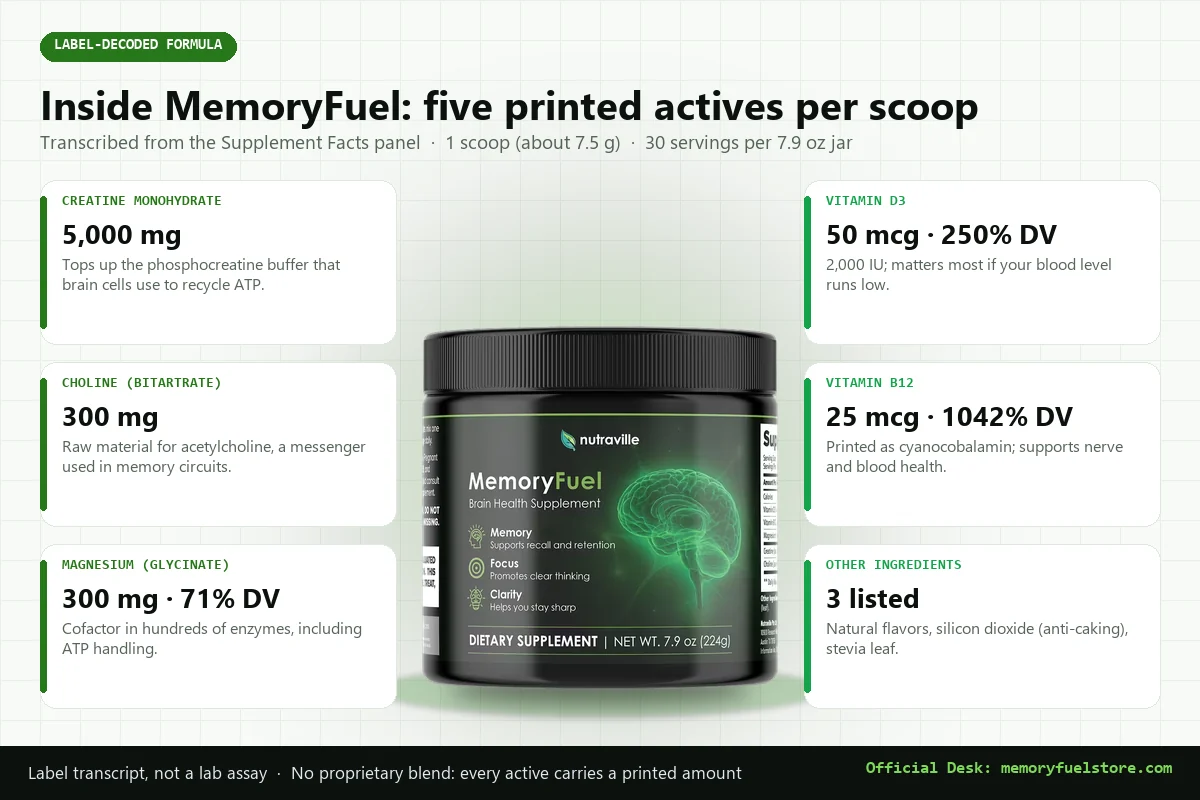
Brain-health powders and multivitamins often include both vitamins at preventive doses, such as 2,000 IU of D3 and 25 mcg of B12 in MemoryFuel. These amounts are reasonable for maintenance. They are not a substitute for testing and treating a real deficiency, which may need much higher doses under medical supervision.
Keep reading
Back to the clinical blog, or see how these ingredients come together in the MemoryFuel Supplement Facts and the ingredient monographs.
Questions about this topic
Can low B12 cause memory loss?
Yes. B12 deficiency can cause memory problems and confusion that may improve with treatment. Ask your doctor for a blood test if you have symptoms.
Does vitamin D prevent dementia?
Observational studies link vitamin D use with fewer dementia diagnoses, but trials have been mixed. Keeping levels normal is sensible; high doses are not proven to protect memory.
Sources for this page
Every source below is linked to the original record. They evaluate ingredients or policies, not the MemoryFuel formula as a finished product.
- 1NIH Office of Dietary Supplements. Vitamin D: Fact Sheet for Health Professionals. ods.od.nih.gov/factsheets/VitaminD-HealthProfessional/
- 2Ghahremani M, Smith EE, Chen HY, Creese B, Goodarzi Z, Ismail Z. Vitamin D supplementation and incident dementia: effects of sex, APOE, and baseline cognitive status. Alzheimers Dement (Amst). 2023;15(1):e12404. pubmed.ncbi.nlm.nih.gov/36874594/
- 3NIH Office of Dietary Supplements. Vitamin B12: Fact Sheet for Health Professionals. ods.od.nih.gov/factsheets/VitaminB12-HealthProfessional/
- 4Eussen SJ, de Groot LC, Joosten LW, et al. Effect of oral vitamin B-12 with or without folic acid on cognitive function in older people with mild vitamin B-12 deficiency: a randomized, placebo-controlled trial. Am J Clin Nutr. 2006;84(2):361-370. pubmed.ncbi.nlm.nih.gov/16895884/
- 5National Institute on Aging. Memory Problems, Forgetfulness, and Aging. www.nia.nih.gov/health/memory-loss-and-forgetfulness/memory-problems-forgetfulness-and-aging
Ready to try MemoryFuel?
Orders complete on the maker's secure ClickBank checkout, with a 90-day refund policy that covers empty jars.