
Creatine for Memory: What the Trials Actually Show at 5 Grams a Day
Creatine went from gym shelves to brain-health ads in a few years. Here is what the human evidence supports, and where the enthusiasm gets ahead of it.
Why a muscle supplement ended up in memory research
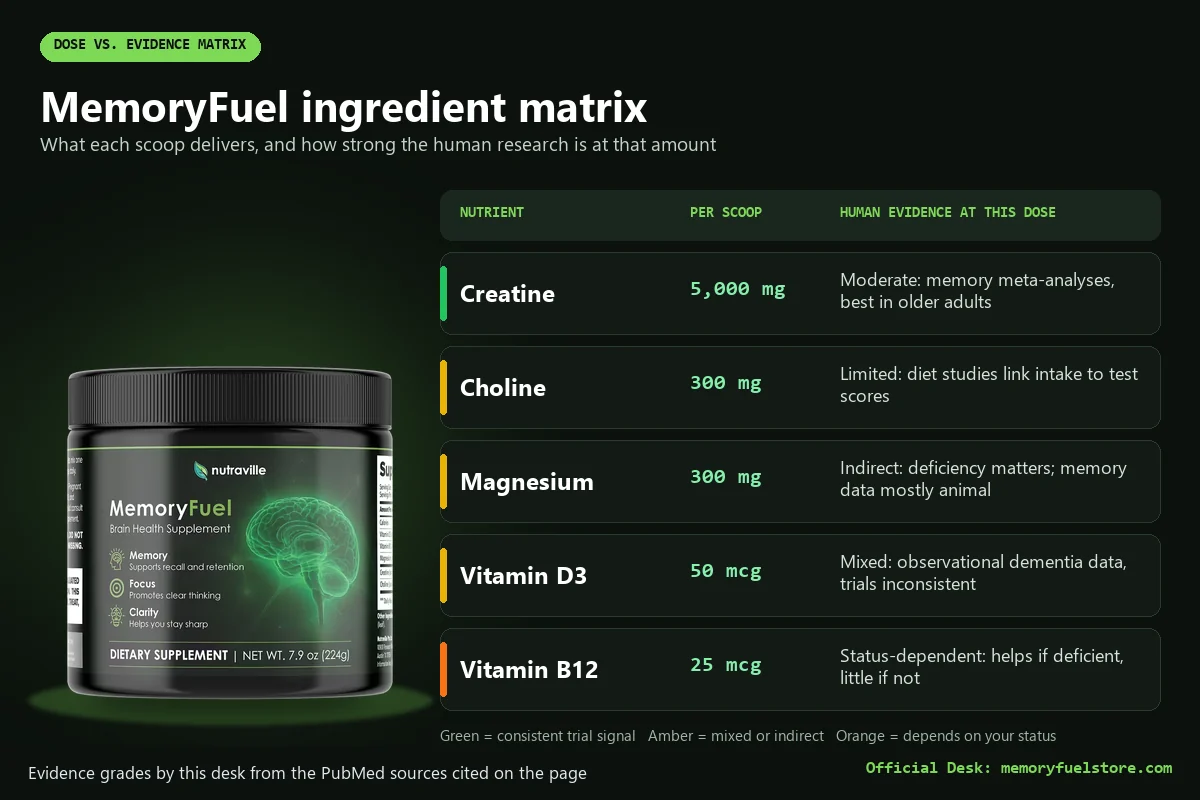
Creatine's job is the same in muscle and brain: it is stored as phosphocreatine and used to regenerate ATP within milliseconds when demand spikes. The brain is a heavy energy user, so researchers asked a reasonable question two decades ago. If supplements raise muscle creatine, do they raise brain creatine, and does that change how the brain performs?
The first part has a clear answer. In an imaging study, 20 g a day for four weeks raised total brain creatine by about 9 percent on average, less than in muscle and unevenly across regions[5]. The brain makes some of its own creatine and imports the rest through a transporter at the blood-brain barrier, which limits how fast stores can climb.
The key trials
- Rae and colleagues, 2003: young adult vegetarians took 5 g a day for six weeks. Working memory (backward digit span) and a reasoning test improved compared with placebo[3]. It is the study most often cited for the 5 g dose.
- Benton and Donohoe, 2011: young women took 20 g a day for five days. Memory improved in vegetarians, with little change in meat eaters[4].
- Gordji-Nejad and colleagues, 2024: a single dose of about 0.35 g per kilogram during sleep deprivation improved processing speed and short-term memory and changed brain energy markers within hours[6]. This is the study behind "works within hours" headlines; note the dose is roughly five times one daily scoop and the setting was a sleepless night.
What the pooled evidence says
A 2018 systematic review of six randomized trials concluded that creatine may improve short-term memory and reasoning, with the clearest results in older adults and under stress, and smaller or absent effects in healthy young people[1].
A 2023 meta-analysis of ten randomized trials reported a small overall improvement in memory and a noticeably larger effect in adults aged 66 to 76[2]. The authors also noted that the studies were small and varied in design, which is why the overall confidence remains moderate.
A 2022 review of creatine and brain health summarized the broader picture: promising effects on cognition under metabolic stress, with more and larger trials needed in healthy aging and in clinical conditions[7].
Who seems to benefit
- Adults over 60 or 65, in whom brain energy handling may be less efficient.
- Vegetarians and others who eat little meat or fish, whose stores start lower.
- People under acute strain such as sleep deprivation or demanding mental work.
- Healthy, well-rested young meat eaters show the least change.
Dose and timeline
Five grams a day is the standard maintenance dose and has an extensive safety record in healthy adults[8]. Loading at 20 g a day for a week fills muscle faster but is not necessary for long-term use and causes more stomach upset. At 5 g a day, expect several weeks before brain stores rise meaningfully. A fair personal trial is six to eight weeks of daily use with brief weekly notes.
Bottom line
Creatine is one of the few supplements with a plausible mechanism and several randomized trials suggesting a modest memory benefit, especially for older adults. It is not a treatment for dementia, the effect is small on average, and it is slow. Products built around a full 5 g dose, such as MemoryFuel, are using the ingredient at the amount studied; the rest of any formula is secondary to that.
Keep reading
Back to the clinical blog, or see how these ingredients come together in the MemoryFuel Supplement Facts and the ingredient monographs.
Questions about this topic
How much creatine do you need for memory?
Most memory trials used 5 g a day for several weeks; some used 20 g a day for a few days. Five grams daily is the usual long-term dose.
How long does creatine take to help memory?
Brain levels rise slowly. Plan on six to eight weeks of daily use before judging.
Sources for this page
Every source below is linked to the original record. They evaluate ingredients or policies, not the MemoryFuel formula as a finished product.
- 1Avgerinos KI, Spyrou N, Bougioukas KI, Kapogiannis D. Effects of creatine supplementation on cognitive function of healthy individuals: a systematic review of randomized controlled trials. Exp Gerontol. 2018;108:166-173. pubmed.ncbi.nlm.nih.gov/29704637/
- 2Prokopidis K, Giannos P, Triantafyllidis KK, et al. Effects of creatine supplementation on memory in healthy individuals: a systematic review and meta-analysis of randomized controlled trials. Nutr Rev. 2023;81(4):416-427. pubmed.ncbi.nlm.nih.gov/35984306/
- 3Rae C, Digney AL, McEwan SR, Bates TC. Oral creatine monohydrate supplementation improves brain performance: a double-blind, placebo-controlled, cross-over trial. Proc Biol Sci. 2003;270(1529):2147-2150. pubmed.ncbi.nlm.nih.gov/14561278/
- 4Benton D, Donohoe R. The influence of creatine supplementation on the cognitive functioning of vegetarians and omnivores. Br J Nutr. 2011;105(7):1100-1105. pubmed.ncbi.nlm.nih.gov/21118604/
- 5Dechent P, Pouwels PJ, Wilken B, Hanefeld F, Frahm J. Increase of total creatine in human brain after oral supplementation of creatine-monohydrate. Am J Physiol. 1999;277(3):R698-R704. pubmed.ncbi.nlm.nih.gov/10484486/
- 6Gordji-Nejad A, Matusch A, Kleedorfer S, et al. Single dose creatine improves cognitive performance and induces changes in cerebral high energy phosphates during sleep deprivation. Sci Rep. 2024;14:4937. pubmed.ncbi.nlm.nih.gov/38418482/
- 7Forbes SC, Cordingley DM, Cornish SM, et al. Effects of creatine supplementation on brain function and health. Nutrients. 2022;14(5):921. pubmed.ncbi.nlm.nih.gov/35267907/
- 8Kreider RB, Kalman DS, Antonio J, et al. International Society of Sports Nutrition position stand: safety and efficacy of creatine supplementation in exercise, sport, and medicine. J Int Soc Sports Nutr. 2017;14:18. pubmed.ncbi.nlm.nih.gov/28615996/
Ready to try MemoryFuel?
Orders complete on the maker's secure ClickBank checkout, with a 90-day refund policy that covers empty jars.